Get more sales, in less time, and with less stress.
Build an agentic revenue system that finds the right opportunities, understands why they matter now, and keeps them moving until a person actually needs to step in.
More qualified opportunities. Less manual prospecting. Better use of the people, data, and tools you already have.
Built around your existing CRM, sales process, marketing stack, and human judgment.
Where could Agentic AI create the most leverage in your revenue process?
You don't need AI everywhere. Answer four quick questions and we'll show you where an agentic system could create the biggest impact across your sales and marketing process.
No email required. See your results instantly.
Revenue is hiding in plain sight.
The problem is, so is everything else.
Potential buyers are already leaving signals. They're sitting in your CRM. Visiting your website. Engaging with your content. Showing intent. Changing roles. Hiring. Expanding. Reappearing after months of silence. Former clients may be ready to buy again. Old opportunities may suddenly have a new reason to move.
The opportunity is there. The problem is separating what matters from everything that doesn't, then having the capacity to research it, prioritize it, act on it, and follow up at the right time.
No person can manually watch every signal across every contact, account, platform, and conversation. And when business gets busy? Prospecting and follow-up are usually the first things to slip.
You don't need more sales activity.
You need a system that knows what deserves action.
Too much noise
Signals are coming from everywhere, but there's no reliable way to separate meaningful opportunity from everything competing for attention.
Too much manual work
Researching accounts, checking signals, qualifying prospects, updating systems, and managing follow-up consumes time that could be spent on higher-value work.
Too many missed moments
The right prospect can be there at exactly the right time and still get missed because no one saw the signal, remembered the follow-up, or knew it mattered.
Too little leverage
You may already have the CRM, the data, the tools, and the marketing. But without an intelligent system connecting them, people are still manually holding the revenue process together.
What if your revenue system could pay attention for you?
Traditional automation waits for a predefined trigger and executes a predefined task. Agentic systems can do more. They can observe what is happening, interpret context, determine what deserves attention, decide what should happen next, take approved actions, and learn from the outcomes.
That changes the role AI can play in sales and marketing. Instead of asking people to constantly search for opportunity, the system helps surface the opportunities that deserve human attention.
Turn the sales and marketing stack you already have into a system that can think and act.
We design agentic sales and marketing systems around the way your business actually creates revenue.
That means we don't start by asking: “What can we automate?”
We start by asking: “What should the revenue process be?”
Then we determine what should be handled by a human, what should be handled by AI agents, what should be automated, what belongs in the CRM, and where judgment or approval should stay firmly in human hands.
The result is not another disconnected AI tool. It is an intelligent operating layer across your existing sales and marketing process.
Strategy first. Then architecture. Then automation.
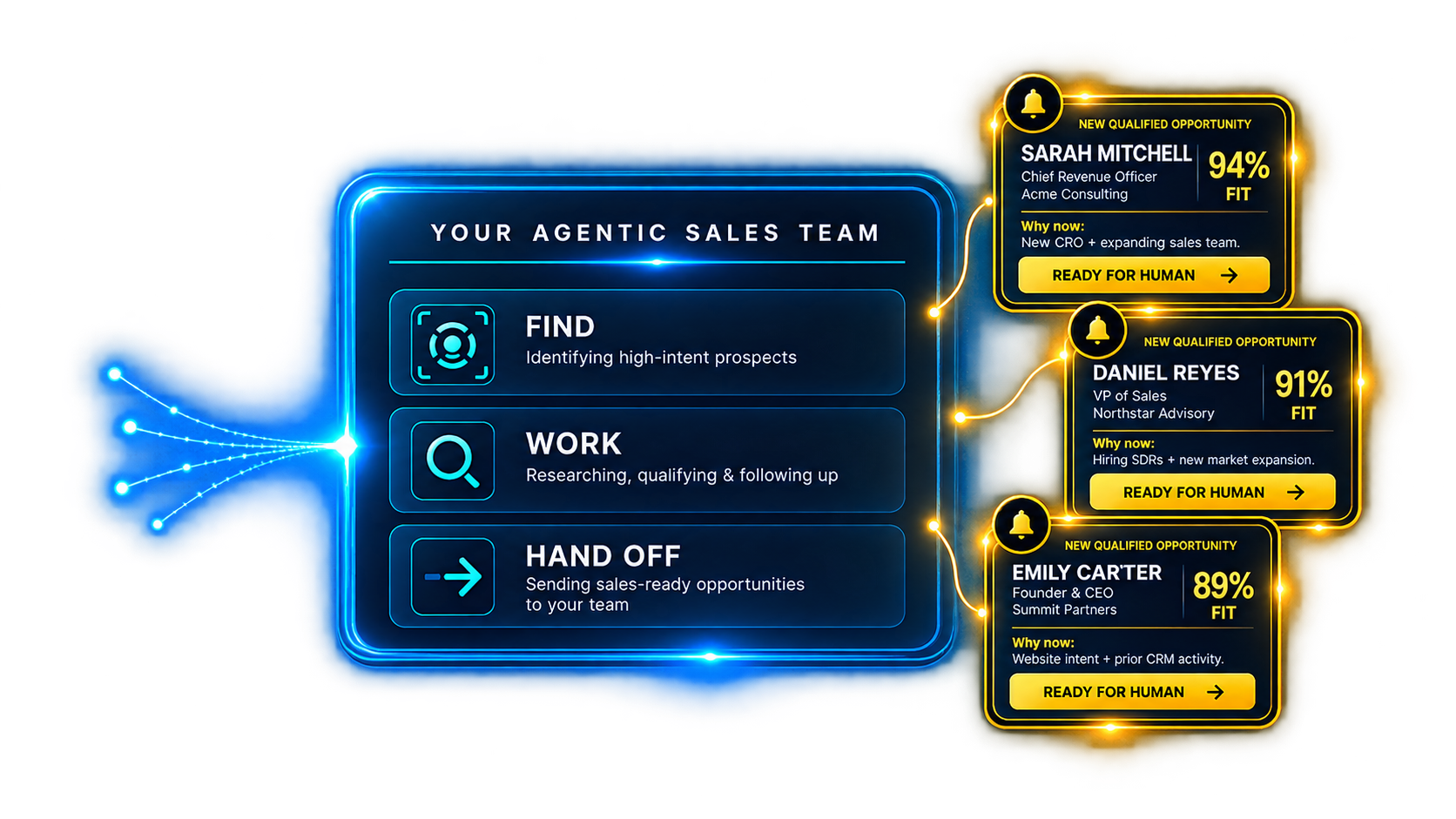
AI handles the work before the conversation.
Humans handle the conversations that matter.
Intelligent Prospect Identification
Spend less time searching for people who were never likely to buy.
Market Moment + Intent Detection
Reach good prospects when there is actually a reason for them to care.
AI Qualification + Prioritization
Know where human attention has the greatest chance of creating revenue.
Account Research + Message Intelligence
Start better conversations without spending 20 minutes researching every account.
Agentic Outreach + Follow-Up
Good opportunities keep moving even when everyone gets busy.
CRM + Pipeline Orchestration
Your CRM becomes part of the revenue engine instead of an expensive filing cabinet.
There may already be revenue sitting inside your CRM.
Businesses often spend enormous energy trying to find new prospects while thousands of previous conversations quietly collect dust. Old leads. Stalled opportunities. Former clients. Prospects who said “not now.” People someone intended to circle back with. Accounts where the original decision-maker has changed.
An agentic system can continuously evaluate that existing pipeline, look for new reasons an opportunity may be relevant, and bring promising conversations back to the surface.
“Not now” should not automatically become “never.”
The goal isn't to remove humans.
It's to stop wasting them.
Not every sales and marketing decision belongs to AI. And not every task deserves human attention. We design the level of autonomy around the decision being made, the risk involved, your brand, your buyers, and your internal process.
Some actions can happen automatically. Some should be prepared by AI and approved by a person. Some should always remain human. The objective is appropriate autonomy: giving the system enough authority to create leverage without handing it decisions it should not own.
AI Can Handle
- Monitoring
- Research
- Classification
- Prioritization
- Administrative updates
- Routine follow-up
AI + Human
- Personalized outreach
- Opportunity strategy
- Complex follow-up
- High-value account planning
Human
- Relationships
- Negotiation
- Judgment
- Trust
- Complex buying conversations
- Closing
More capacity without simply adding more people.
Better opportunities surface faster
Instead of treating every lead equally, the system helps identify which accounts deserve attention now.
Prospecting becomes continuous
Pipeline development does not disappear just because delivery, meetings, or client work gets busy.
Follow-up stops depending on memory
Good opportunities can remain active over weeks or months without someone constantly managing every reminder manually.
Existing data becomes more valuable
Your CRM, website activity, intent data, marketing engagement, and market signals become inputs into a smarter revenue process.
Humans spend more time where humans matter
Research, sorting, monitoring, and repetitive sales administration stop consuming the same amount of human capacity.
Your revenue system can learn
Replies, meetings, opportunities, sales outcomes, and lost deals create feedback that can improve how the system prioritizes and acts over time.
Your CRM does not need to become another expensive migration project.
Most businesses already have more technology than they fully use. We are not interested in replacing useful systems just so we can sell you another one. Where practical, we build the agentic layer around the tools you already use.
The goal is not more software. The goal is making the software, data, people, and processes you already have work together intelligently.
Built for businesses where one good opportunity is actually worth pursuing.
Agentic Sales + Marketing is most valuable when your business already has a proven offer, meaningful customer value, and enough market activity that missed opportunities carry a real cost.
Strong Fit
- B2B consulting firms
- Professional services
- Technology and IT services
- Cybersecurity and MSPs
- Corporate training and leadership firms
- Recruiting and executive search
- B2B agencies
- High-value SaaS
- Specialized commercial and industrial services
- Founder-led businesses moving beyond referral-only growth
Probably Not Yet
- —Pre-revenue companies
- —Businesses still trying to determine what they sell
- —Very low-ticket transactional offers
- —Companies with no meaningful sales motion to improve
- —Organizations looking only for a generic chatbot or one-off automation
We don't automate broken processes faster.
We map how opportunity currently enters, moves through, and disappears from your revenue process. We identify bottlenecks, unused data, manual work, missed follow-up, and the places where human attention is being wasted.
We design the revenue workflow before choosing the agents. We determine the signals, decision logic, data sources, system roles, human checkpoints, CRM behavior, and appropriate level of autonomy.
We connect the necessary data, agents, automation, CRM logic, research, qualification, messaging, and handoff workflows.
We launch the system, observe real-world behavior, measure what creates qualified conversations and opportunity, and improve from actual outcomes.
We don't start with tactics. We start with the part of the system that's actually blocking growth.
What could an agentic revenue system look like in your business?
Dormant Pipeline Reactivation
Your CRM is continuously reviewed for previous prospects, lost opportunities, former clients, and “circle back later” conversations. When new context makes an account relevant, the opportunity resurfaces with research and a recommended next action.
High-Intent Prospecting
The system identifies target accounts showing relevant buyer or market signals, researches why the timing matters, prioritizes them, and prepares the appropriate outreach.
Inbound Lead Intelligence
Instead of treating every website visitor or inbound lead equally, the system enriches, researches, qualifies, prioritizes, routes, and follows up based on actual opportunity.
Founder-Led Sales Support
An owner or executive gets a continuously prioritized stream of qualified opportunities instead of spending hours researching accounts and trying to remember who needs follow-up.
Sales Capacity Expansion
An existing sales organization uses agents to handle research, prioritization, CRM administration, early follow-up, and signal monitoring so human sellers can focus on conversations and closing.
The system finds the conversation. You show up for it.
Agentic AI does not replace the fundamentals of selling. It runs them continuously: sharper audience intelligence, better timing, follow-up that never drops, and a clean path from buying signal to booked conversation.
These campaigns prove the playbook. Agentic systems are how we now run that playbook across more accounts, more signals, and more conversations than a team can manage by hand.
Built for founders, consultants, and B2B service firms that want pipeline without building an SDR department.
Every week without new sales conversations was revenue left on the table. But prospecting and follow-up kept losing to client delivery and everything else it takes to run the business.
A repeatable engine: a defined target audience, a structured outreach approach, a conversation flow that qualified interest instead of just collecting replies, and a handoff process so a warm prospect landed on the calendar instead of in a forgotten inbox.
The campaign generated 6 meetings in one week.
This is the exact loop an agentic sales system runs on its own: identify the right account, take the right action, and escalate to a human the moment the conversation is worth a human's time. What we engineered here by hand, an agent now runs around the clock.
The agency could generate attention all day. What it needed was pipeline. Engagement, content views, and event registrations were not turning into sales conversations, and the team did not have a system to make that conversion happen.
A LinkedIn-led campaign around a targeted event and lead magnet, with deliberate audience selection, messaging, follow-up, and a defined path from first interest into a sales conversation.
The campaign generated 150+ registrations and approximately 17 scheduled sales and strategy calls.
A registration is a buying signal. The value is in what happens next. Agentic systems watch for that signal across every channel, decide who deserves follow-up, and route the right people toward a conversation without waiting for someone to work the list.
A software company with a large, well-defined target market and no scalable way to work it. Manually researching, contacting, monitoring, and following up with thousands of prospects would have consumed the team and still left most of the list untouched.
An audience-to-pipeline campaign that moves a large qualified audience through outreach while surfacing the people showing real interest, so the team only engages where there is a signal.
From the first 595 prospects reached:
- 29 direct replies
- 6 asked for information about the pipeline offer
- 2 independently booked website mockups
These are campaign activity and opportunity metrics from an active campaign, not closed-revenue claims.
This is where agents earn their keep. Instead of treating 595 contacts as 595 identical tasks, the system sorts who is responding, who is signaling intent, what deserves follow-up, and when a human needs to step in. Their team spends its time on the 29, not the 595.
Because this isn't really an AI problem.
It's a revenue strategy problem.
Anyone can connect tools. The harder question is deciding what the system should actually do.
Who should you pursue? What makes someone qualified? Which signals matter? When should outreach happen? What should the message say? When should AI act? When should it wait? When should a human step in? And how should the system learn from what actually produces revenue?
Influence Builder works across positioning, market strategy, buyer intelligence, demand generation, sales process, messaging, CRM architecture, and AI. That allows us to design the revenue strategy first, then use AI to create leverage around it.
AI should accelerate a good revenue strategy.
It should not become a substitute for one.
What leaders ask before we build.
Do we need to replace our CRM?
Usually, no. We prefer to work with useful systems you already have and build the agentic layer around them where practical.
Is this just sales automation?
No. Traditional automation generally follows predefined rules. Agentic systems can observe context, research, interpret signals, prioritize opportunity, determine next actions, and operate within an approved level of autonomy.
Will this replace our salespeople?
The goal is not to replace people. It is to reduce the amount of human time spent researching, sorting, monitoring, updating, and chasing routine follow-up so people can focus on conversations, relationships, judgment, and closing.
What if we don't have a sales team?
That can make the opportunity even more meaningful. Founder-led and executive-led sales often break down because the person responsible for selling is also responsible for everything else. An agentic system can handle much of the work that needs to happen before a human conversation.
What if our CRM is messy?
That is common. Part of the work may involve determining which data can be trusted, what needs to be cleaned, what information should be captured going forward, and where the system needs guardrails.
How much control does AI have?
That depends on the workflow. We use appropriate autonomy. Some tasks can run automatically, some actions require human approval, and some decisions should always remain human.
Can we start with one revenue workflow?
Yes. In many cases the smartest approach is to start with one high-value problem, prove the workflow, and expand from there.
Does this guarantee more sales?
No system can honestly guarantee a sale. The objective is to improve the number of qualified opportunities identified, acted on, followed up with, and moved toward meaningful human conversations.
Build the system that knows what deserves action.
Your next qualified opportunity may already be in your CRM, on your website, inside your data, or somewhere in the market signaling that the timing has changed. The question is whether anyone will see it and act before the moment passes.
Strategy first. Appropriate autonomy. Revenue always.